Artificial intelligence has changed the starting point for structural biology. Protein structure prediction tools such as AlphaFold can generate highly accurate structural models for many proteins, including proteins for which experimentally determined structures are unavailable. These models can help researchers investigate potential binding sites, formulate structural hypotheses, prioritize experiments and explore targets earlier in a drug discovery program.
For many targets, that represents a substantial advance. But obtaining a structural model is not necessarily the same as understanding the protein's conformational dynamics. A protein in solution is not always well described by a single conformation. Depending on its sequence, environment and interaction partners, it may populate multiple conformational states and exchange between them. Ligand binding, mutations, post-translational modifications and changes in experimental or formulation conditions can shift those populations. For drug discovery, these changes can influence molecular recognition, selectivity, allostery, stability and the accessibility of binding sites that may not be apparent in a single structural model.
This creates an important question for researchers using AI-generated protein structures: how does an AlphaFold protein structure relate to the conformational ensemble that the protein actually samples under experimentally relevant conditions? The distinction is becoming increasingly important as computational approaches move beyond predicting a single structure toward describing alternative conformations and structural ensembles. Recent work has demonstrated approaches for using experimental measurements to guide AI-based structure prediction, including the incorporation of DEER distance distributions into AlphaFold2-based modeling and, more recently, experimental guidance of AlphaFold3 to generate measurement-consistent protein ensembles.
The emerging opportunity is therefore not simply to choose between computational prediction and experimental characterization. It is to use them together to obtain a more informative description of protein structure and conformational behavior.
From a Predicted Structure to a Conformational Ensemble
A structural model provides a representation of a protein's three-dimensional organization. For many applications, that representation is extremely useful. It can help identify potential ligand binding pockets, formulate hypotheses about molecular interactions, support molecular design and provide a framework for interpreting experimental observations. The challenge arises when the biological question depends on more than one structural state.
Consider a simplified system in which a protein exists as:
State A ⇌ State B ⇌ State C
The protein does not necessarily spend equal amounts of time in each state, and the relative populations may change when a ligand binds or when another binding partner is introduced. One conformation may expose a binding site that is partially inaccessible in another. A regulatory site may communicate with a distant region through changes in the conformational ensemble. A flexible region may adopt different structures depending on its environment.
In such cases, describing the protein using a single structure can obscure information that is relevant to its function. This does not mean that a predicted structure is incorrect. Rather, the model may represent one structural state or provide a structural hypothesis within a system that is inherently heterogeneous. The experimentally relevant question is then not simply whether the predicted structure looks plausible, but whether the corresponding state is populated and how the ensemble changes under the conditions being studied.
That distinction between a structure and a conformational ensemble is particularly relevant to drug discovery because molecular recognition can involve structural states that are not equally populated.
Why Protein Dynamics Matter for Drug Discovery
The functional behavior of many drug targets depends on conformational changes. Ligand binding can alter the distribution of states available to a protein, while pre-existing conformational states can influence which ligands are able to bind. One commonly discussed mechanism is conformational selection, in which a ligand preferentially binds to a pre-existing protein conformation. In this case, ligand binding can shift the population toward a state that was already present in the unbound ensemble.
In induced fit, binding is followed by a conformational rearrangement that contributes to formation of the bound state. In real systems, conformational selection and induced fit are not necessarily mutually exclusive descriptions, and both mechanisms can contribute to the observed binding pathway. Distinguishing their contributions generally requires kinetic and structural information rather than a static structure alone.
The same principle applies to allostery. A perturbation at one site can alter the conformational ensemble at another, even when the two regions are separated in the primary sequence and structure. Understanding that coupling can be important when identifying regulatory sites or developing molecules designed to modulate protein activity indirectly.
Conformational heterogeneity can also influence the accessibility of cryptic or transient binding sites. A pocket that is poorly represented in a dominant structural model may become accessible in an alternative state. If that state is relevant to ligand recognition, characterizing the ensemble can provide information that would be difficult to obtain from a single static structure. For these reasons, protein dynamics are not simply an additional layer of structural biology. In some discovery programs, they form part of the molecular mechanism that determines how a target recognizes and responds to a molecule.
What Can AlphaFold Tell You About Protein Dynamics?
AlphaFold has substantially expanded the ability to generate protein structural models from sequence, but understanding AlphaFold protein dynamics requires considering what those models represent and what they leave unresolved.
AlphaFold and related approaches have substantially expanded the ability to generate protein structural models from sequence. They have also motivated a broader question: whether information learned from large structural databases can be used to predict aspects of conformational variability rather than only a single dominant structure.
That question is already being explored computationally and experimentally. For example, a 2025 Nature Communications study introduced AlphaFold-Metainference, which uses AlphaFold-derived inter-residue distances as structural restraints within molecular dynamics simulations to construct structural ensembles for disordered proteins and proteins containing disordered regions.
The approach illustrates an important distinction: for a disordered protein, the relevant prediction problem is not necessarily the identification of one native structure, but the construction of an ensemble that represents its heterogeneous and dynamic conformational state. More broadly, recent work is moving toward experimentally informed structure prediction. A 2026 Nature Biotechnology study described an approach that modifies the AlphaFold3 generative process so that experimental likelihoods can guide sampling. The framework was demonstrated using measurements from NMR spectroscopy, X-ray crystallography and cryo-EM, as well as data that report on dynamics such as site-resolved order parameters. The resulting structural ensembles were designed to be consistent with the experimental measurements.
Understanding these AlphaFold limitations becomes particularly important when the biological question depends on conformational heterogeneity, ligand binding or environmental conditions. These developments change how the limitations of AI-based structure prediction should be framed. The question is no longer simply whether AI can or cannot predict protein dynamics. Researchers are actively developing methods to generate alternative conformations and experimentally constrained ensembles. The practical challenge is determining which conformations are relevant under the conditions of a particular experiment or drug discovery question, and how well computational models describe those states.
That is where experimental protein characterization becomes particularly valuable.
How Do Researchers Experimentally Investigate Protein Dynamics?
No single experimental method provides a complete description of protein conformational behavior. Different techniques report on different structural features, timescales and types of heterogeneity.
NMR spectroscopy can provide residue-level information about local chemical environments and molecular motions across a range of timescales. It is particularly valuable for studying conformational exchange and flexible regions in solution.
Hydrogen deuterium exchange mass spectrometry (HDX-MS) measures rates of hydrogen/deuterium exchange and can provide information about solvent accessibility, hydrogen bonding and changes in protein dynamics. Comparing exchange behavior between states can reveal regions affected by ligand binding, protein interactions or other perturbations.
Cryo-electron microscopy can capture structural heterogeneity in suitable macromolecular systems and, in appropriate cases, resolve or classify multiple conformational states within a sample.
FRET can provide information about distances between fluorescent labels and is widely used to monitor conformational transitions and molecular interactions, including measurements performed at the single-molecule level.
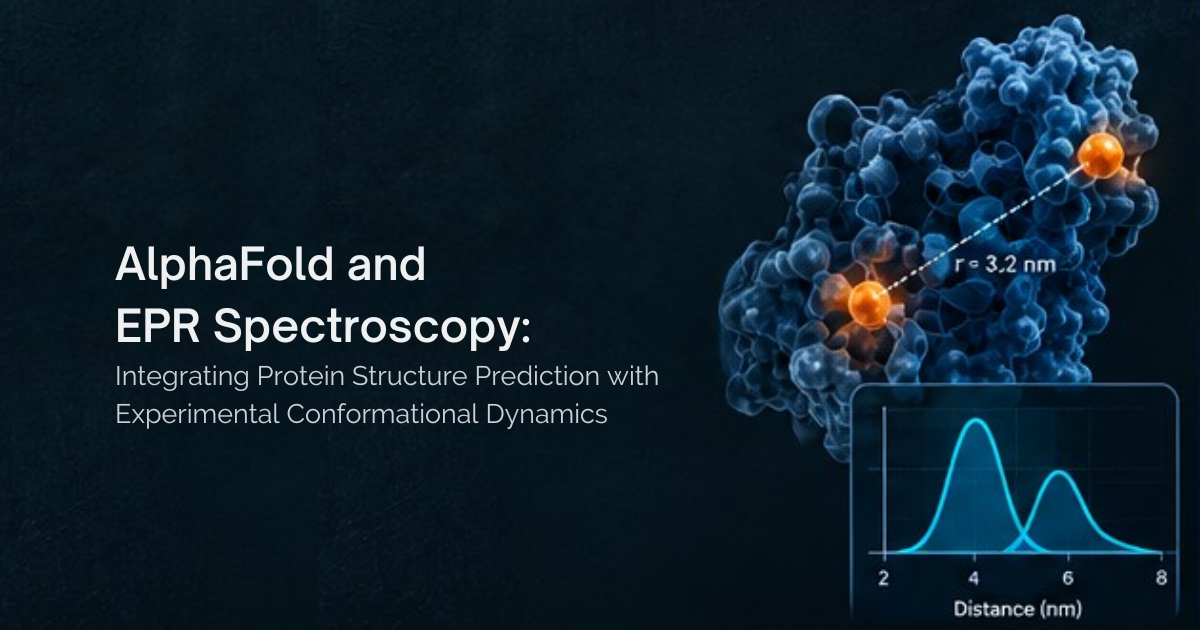
EPR spectroscopy, including pulsed methods such as double electron-electron resonance (DEER), provides another route to investigating structural heterogeneity and long-range distance information. With appropriate site-directed spin labeling, researchers can measure distributions of distances between spin labels and examine how those distributions change between experimental conditions. For some protein systems, that ability to observe a distance distribution rather than a single average distance is particularly informative.
What Does DEER Actually Measure in Protein Dynamics?
DEER is a pulsed EPR technique used to determine distances between pairs of electron spins, typically introduced into a protein through site-directed spin labeling. The measurement does not simply return a single distance between two points on a protein. Instead, the experimental signal can be analyzed to obtain a distribution of distances between the spin labels. The shape and breadth of that distribution can contain information about structural heterogeneity, while changes in the distribution between experimental conditions can indicate changes in the underlying conformational states.
This makes DEER particularly useful when the question concerns whether a protein occupies more than one structural state. For example, a protein could exhibit different distance distributions in the absence and presence of a ligand. A shift in the distribution, the appearance of additional components or changes in its breadth may be consistent with a change in the populations or structural arrangements sampled by the protein. However, the DEER distance distribution should not be interpreted as a direct, complete description of the protein conformational ensemble. The measured distances are between spin labels, and interpretation depends on the location and conformational behavior of the labels as well as on the relationship between spin label positions and the underlying protein structure. Spin label modeling is therefore an important component of extracting structural information from DEER data. When combined with structural models and complementary measurements, DEER data can provide experimentally derived constraints on the conformations that are consistent with the observed distance distributions.
When AI Meets DEER Spectroscopy
The combination of AI-based structure prediction with experimental distance measurements is beginning to provide a way of connecting predicted structures with experimentally observed conformational heterogeneity.
A 2025 Nature Communications study by Wu and colleagues demonstrated DEERFold, a modified AlphaFold2-based approach that incorporates experimental DEER distance distributions into the model. Using the OpenFold implementation of AlphaFold2, the researchers integrated DEER-derived spin-label distance information into the pair representation used by the model and demonstrated that these experimental constraints could guide predictions toward alternative conformations.
The significance of this type of approach is not that DEER simply "validates" AlphaFold. The more useful interpretation is that the two approaches provide different kinds of information. A sequence-based structure prediction provides a computational prior for plausible protein structures. DEER provides experimental information about distances between selected sites and, importantly, about the distribution of those distances within the sample. These constraints can help identify structural models or conformational states that are consistent with experimentally observed behavior. This represents a shift from a simple prediction-and-validation workflow toward an experiment-informed modeling workflow.
From Prediction to an Experimentally Informed Ensemble
A practical workflow might therefore begin with an AI-generated structural model that provides a starting hypothesis for the protein. Researchers can then identify regions where conformational variability is biologically relevant and select sites for experimental characterization. With appropriate labeling, DEER measurements can provide distance distributions for selected site pairs. Measurements can be performed under different conditions, such as in the presence and absence of a ligand or binding partner. The resulting experimental data can then be compared with computationally generated structural states.
Conceptually, the workflow becomes:
AI structure prediction → experimental measurement → comparison with observed distance distributions → structural interpretation → model refinement
The objective is not necessarily to produce one definitive structure. In a heterogeneous system, a more useful result may be a set of structural states that collectively provides a better explanation of the experimental observations. The 2026 AlphaFold3 work illustrates how this broader concept is developing. The researchers modified the AlphaFold3 generative process so that experimental likelihoods guide structural sampling, producing compact ensembles whose ensemble-averaged observables agree with experimental measurements. Importantly, the authors distinguish these experimentally constrained ensembles from fully calibrated thermodynamic or Boltzmann equilibrium ensembles.
That distinction is important in experimental interpretation. An ensemble that explains a set of measurements is not automatically a complete description of the protein's thermodynamic landscape. Experimental conditions, labeling strategy, model assumptions and the information content of the measurements all influence what can be inferred.
Nevertheless, experimentally informed modeling offers a way to move beyond asking whether one predicted structure is "right" and toward asking which structural states are supported by the available evidence.
What About Intrinsically Disordered Proteins?
The distinction between structure and ensemble becomes even more important for intrinsically disordered proteins (IDPs). Unlike a well-folded protein that may populate a relatively stable structural state with localized fluctuations, an intrinsically disordered region can sample a broad range of conformations. In these systems, describing the protein using a single three-dimensional structure can be fundamentally inadequate. Recent work has therefore explored whether AI-based structural information can be combined with simulation and experimental data to construct ensembles for disordered proteins. The 2025 AlphaFold-Metainference study is one example of this direction, using AlphaFold-derived inter-residue distances as restraints within a metainference-based molecular dynamics framework to construct ensembles for disordered proteins and proteins containing disordered regions.
For drug discovery, this is relevant because disorder does not necessarily mean that a protein is structurally uninformative. Disordered regions can participate in molecular recognition, regulation and protein-protein interactions, and their conformational behavior can change in response to binding partners or other perturbations.
The analytical challenge is simply different. Instead of asking which single structure represents the protein, researchers may need to determine which ensemble of conformations is consistent with the available experimental evidence and relevant to the biological question.
What This Means for Protein Characterization
The increasing use of AI in structural biology does not make experimental characterization less relevant. In many cases, it changes the question experimental characterization needs to answer. A predicted structure can provide a useful starting point for experimental design. It can help researchers formulate hypotheses about possible conformational states and determine which structural features may be important to investigate. Experimental measurements can then provide information that is difficult to infer from a single computational model, particularly when the protein exhibits conformational heterogeneity or changes state in response to a ligand or binding partner.
For an early drug discovery program, this distinction can matter when deciding how much structural characterization is warranted. Not every target requires a detailed conformational ensemble. But when activity, selectivity, binding or stability depends on structural transitions, information about protein behavior can complement the static picture provided by a predicted or experimentally determined structure. The resulting characterization strategy can therefore be more targeted: use computational models to establish structural hypotheses, select experiments that address the most consequential uncertainties, and integrate the resulting measurements back into the structural interpretation.
Where FATHOM EPR Fits
FATHOM EPR provides an experimental platform for investigating protein structure and conformational behavior using electron paramagnetic resonance methods, including pulsed EPR measurements such as DEER.
For researchers investigating conformational heterogeneity, the ability to measure spin-label distance distributions can provide experimental information that complements computational structure prediction. These measurements can be used to investigate structural changes associated with ligand binding, protein interactions or other perturbations and to provide experimental constraints for structural interpretation. As AI-based approaches increasingly move toward alternative conformations and experimentally informed ensembles, experimental measurements such as DEER can provide an important connection between predicted structural models and the behavior observed in the laboratory.
From Protein Structure to Protein Behavior
The value of AI-based protein structure prediction is not diminished by recognizing that proteins are dynamic.
A predicted structure can provide an important structural hypothesis. The next question is how that hypothesis relates to the ensemble of states populated by the protein under the conditions that matter for the biological or drug discovery problem. That is where experimental characterization becomes complementary to prediction.
NMR, HDX-MS, cryo-EM, FRET and EPR each provide different perspectives on protein behavior. DEER is particularly useful when distance distributions and conformational heterogeneity are central to the question. Recent work combining DEER measurements with AlphaFold2-based modeling, together with newer approaches for experimentally guided AlphaFold3 ensemble generation, demonstrates how experimental observations can increasingly be incorporated into computational approaches for describing alternative protein conformations.

The direction of the field is therefore moving beyond the question of whether AI can predict a protein structure. The more useful question may be how computational models and experimental measurements can be combined to determine which structures a protein actually samples, how those populations change, and which of those states matter for molecular recognition and drug discovery.