Drug discovery cannot happen in a vacuum – it requires a constant influx of new ideas, information, and technology to advance. During my recent attendance at Discovery on Target, there was a consistent underlying message that despite the proprietary nature of an organization’s approach, drug discovery is a group effort. With collaboration a key theme throughout the conference, I want to expand on some of the more salient talking points, and how I believe High Q and the EPR community can contribute to the conversation.
In Corey Strickland’s presentation (Proteovant Therapeutics), he talked about a platform to identify promising molecular glues, stating, “glue discovery is serendipitous.” While many important scientific advancements have come from unintentional or even accidental circumstances, the scientific method works best when experiments and hypotheses can be rationally formulated. However, such design can only come with a deeper understanding of the problems and systems at hand. For molecular glues, we need further structural and dynamic insights into the mechanism of complex formation to deconvolute, reverse engineer, and build upon known modes of action. In previous posts, I’ve talked about the power of EPR to assess protein-protein docking and supramolecular complexes, and the point is reiterated here – EPR distance constraints coupled with existing structural data can provide valuable insight into these structural aspects, taking the serendipitous to the systematic.
Perhaps the most insightful session was a panel discussion on the various biophysical tools applied in the drug discovery pipeline. A statement that really resonated with me was that “every technique has its blind spot.” As a spectroscopist it is easy to view science through the lens of your technique of choice – when you have a hammer in hand, every problem looks like a nail. It is therefore important to consider the complementary nature of any given technique. Everything has its limitations, and we must search for new means by which to gain that missing information. EPR addresses some significant blind spots in many of today’s common structural biology tools by providing rich dynamic information that is otherwise difficult if not impossible to resolve otherwise. The more we can expand our toolbox, the more information we have at our disposal, allowing us to better tackle the pressing issues.
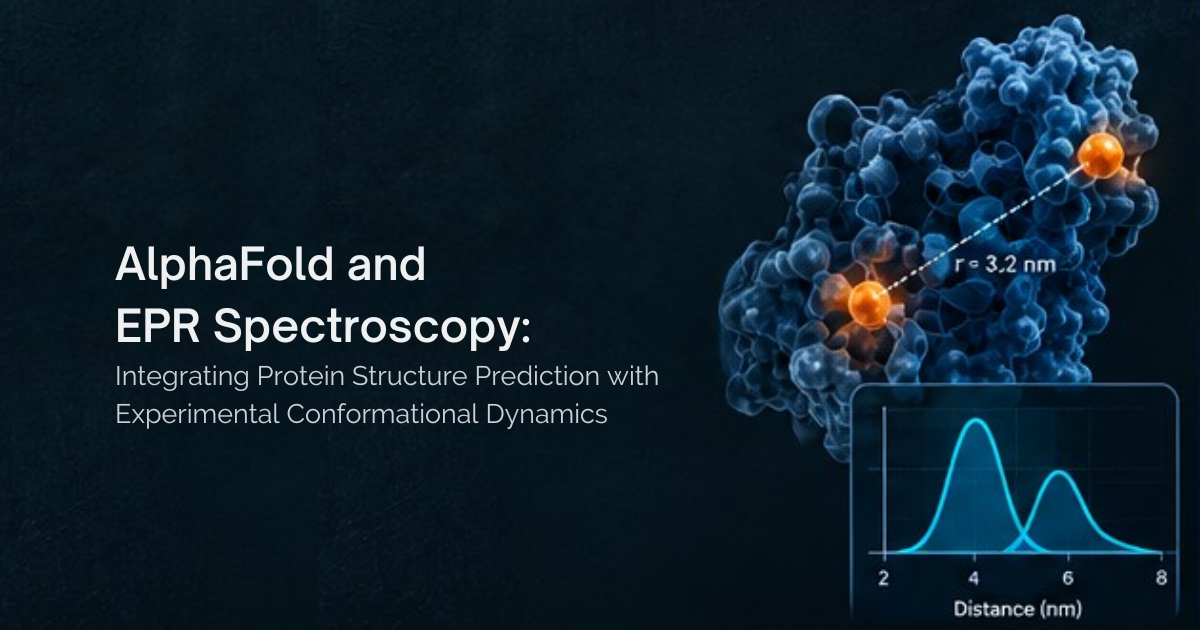
Another message that was reiterated throughout the conference was the importance of not only identifying new solutions to problems, but also having confidence in the results. Employing a variety of orthogonal methodologies and approaches validates findings and reduce the risk of errors or biases that might arise from using a singular method. As noted, each analytical technique has its blind spots, and it is only through the integration of these various methods that we see the full picture. In recent years, there has been revolutionary work around protein structural determinations by newer techniques such as Cryo-EM, AlphaFold, and others, but even they require validation. Protein structure can be heavily influenced by environment, so ensuring that a structure agrees between Cryo-EM grid conditions and its native environment is key to physiological insight. AlphaFold is incredibly powerful for generating accurate structural predictions, but those predictions still benefit from empirical verification. EPR point-to-point distances offer simple assays to validate structural conclusions.

EPR is a strong complement to the state of the art in structural biology, providing a wholistic view of a target protein. In tandem with other techniques, it can help us to deepen our understanding of biological structure and function and validate proposed mechanisms. Moreso, and in the spirit of collaboration, I am excited not only at the prospect of how EPR can help advance the field of drug discovery, but also how drug discovery can progress the application of EPR and the historically complex problems we can solve that would be unreachable alone.