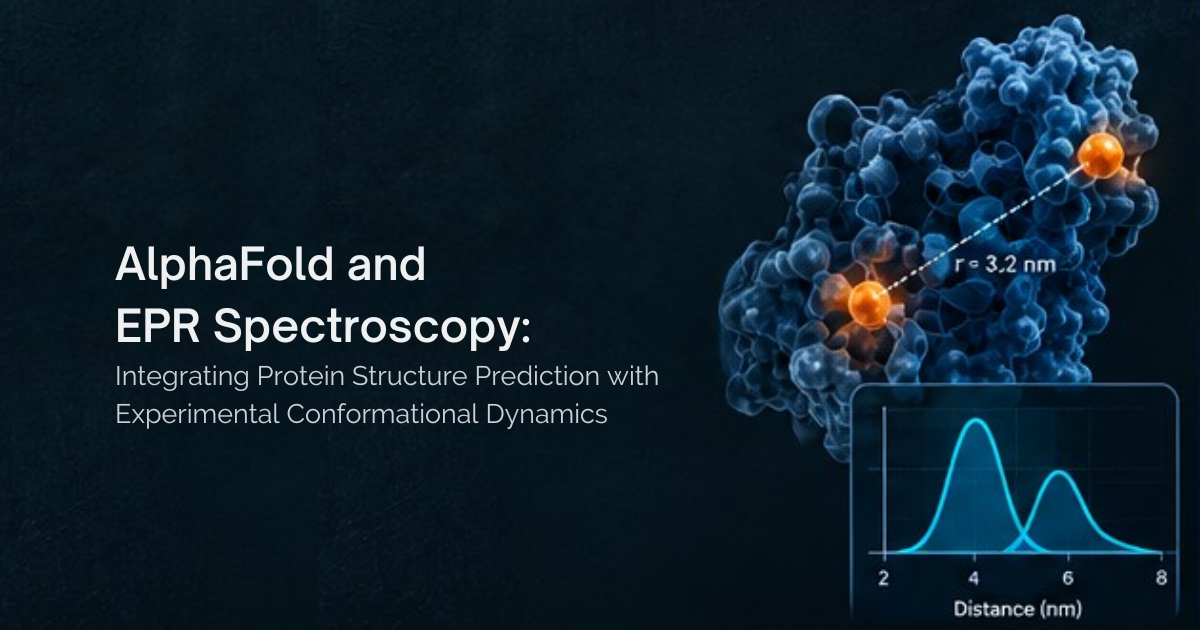
As structural biology/drug discovery moves toward ensemble-based views of proteins, Electron Paramagnetic Resonance (EPR) spectroscopy is becoming one of the most important techniques for studying biomolecular dynamics. EPR studies are increasingly being used to complement existing structural data from techniques like Cryo-EM, NMR, or X-ray Crystallography, providing dynamic information that can be difficult to obtain otherwise. In this post, we will take a look at Electron Paramagnetic Resonance spectroscopy (EPR), and why it keeps showing up in protein dynamics studies.
What Is EPR Spectroscopy?
Electron Paramagnetic Resonance (EPR) spectroscopy is a technique that detects unpaired electron spins, and can use those spin signals to uncover a host of biophysical information. In the context of biological samples, however, most biomolecules do not natively contain unpaired electron spins. There are exceptions, typically in metalloproteins containing endogenous paramagnetic transition metal ions like Cu(II) or Fe(III), or transient radical intermediates like tyrosyl radicals. This makes EPR an incredibly selective technique, having little to no competing background signals in most cases. For the majority of biological samples that don’t contain paramagnetic centers, they can still be studied by EPR using Site-Directed Spin Labeling (SDSL), a process in which stable radicals, typically organic nitroxides, are attached at site specific point mutations within the macromolecule. These spin labels act as molecular reporters that can probe local dynamics, solvent accessibility, mobility, and more.
When two or more spin labels are attached to a biomolecule, a new class of experiment is enabled that measures the interspin distance between labels, on a scale from ~2 to ~8 nm. Such distance measurements have gained prominence in recent decades as an excellent probe for conformational dynamics, structural heterogeneity, and complex or oligomer arrangement.
Learn about spin labels here: Spin Class: EPR’s Long Distance Relationships
How Does EPR Spectroscopy Work?
As the name implies, EPR is a magnetic resonance technique. It is also sometimes referred to as Electron Spin Resonance (ESR). Electrons possess ‘spin’, an intrinsic property, as well as a magnetic moment, such that the electron spin can effectively interact with an external magnetic field. In a classical approximation, when an external magnetic field is applied the spin magnetic moments can align parallel or antiparallel. These states have different energies - parallel is lower energy whereas antiparallel is higher. When the energy difference between states is matched by applied microwave radiation, a transition occurs, forming the basis of the EPR signal.
Continuous-Wave (CW) vs Pulsed EPR Spectroscopy
EPR experiments generally fall into two categories: continuous wave (CW) and pulsed.
Continuous-Wave Spectroscopy
In CW EPR, microwave radiation is continuously applied to the sample. The external magnetic field may then be swept in strength, detecting the spectrum of resonance conditions of the particular sample. This EPR spectrum is sensitive to electronic structure and local environment, being affected by coupled and nearby nuclei, other electrons, and relaxation properties. Much like an NMR spectrum, the EPR spectrum can be used as a sort of ‘fingerprint’ identifier, giving clear insights into the identity of the radical. This can be especially useful for studying transition metal ions, which are highly sensitive to the local coordination environment.
Pulsed EPR Spectroscopy
Alternatively, pulsed EPR applies microwaves in short, nanosecond-scale pulses. These pulses are timed to precisely manipulate packets of spins, rotating them in specific ways to isolate various interactions or physical processes, similar to many NMR experiments. Such experiments extract information regarding electron-electron dipolar interactions, relaxation properties, and nuclear coordination. Common pulsed EPR experiments include Electron Spin Echo Envelope Modulation (ESEEM), Electron-Nuclear Double Resonance (ENDOR), and Double Electron-Electron Resonance (DEER).
What is DEER Spectroscopy?
DEER, also known as Pulsed Electron Double Resonance (PELDOR), has direct, obvious, and powerful implications to the immediate needs of structural biologists. DEER belongs to a subset of EPR experiments called Pulsed Dipolar Spectroscopy (PDS). While there are several key PDS experiments, DEER remains the most popular choice, being conceptually straightforward, robust, and well-studied. DEER isolates the dipolar interaction between coupled electron spins, producing a signal from which the interspin distance can be extracted. The ideal distance range for DEER experiments is 2-8 nm, although it is possible to exceed that limit through careful sample preparations. 1.5-8 nm is a sufficient range to measure length scales common to domain motions, allosteric transitions, and conformational rearrangements that inform on ligand binding, selectivity, and efficacy. Notably, DEER data yields a probability distribution of distances, rather than a static mean distance. This distribution gives direct insight into flexibility and conformational heterogeneity, reporting on all conformations within the sampled ensemble.
Experimentally, DEER involves observing a packet of spins while ‘pumping’ or flipping a spectrally separate packet of spins at varied timings relative to the observation. The flipped spins alter the magnetic environment of the observed spins, which impacts their measured EPR signal. Measuring this signal over a length of time results in an EPR signal that modulates with a damping oscillation. The frequency of this oscillation is related to the inverse of the spin-spin distance cubed. Fast oscillations indicate short distances, while slow oscillations indicate long distances. The rate of damping relates to the flexibility of the system, or how broad or narrow the resulting distance distribution is - rapid damping indicates a broad, flexible distribution, while slow damping indicates a narrow, rigid distribution. DEER is performed on flash frozen sample ensembles, so if there are multiple distinct conformations present, the distance distribution can exhibit multiple peaks, providing direct insight into conformational dynamics and heterogeneity. This ability to observe structural ensembles is a significant advantage of using DEER, and can be invaluable for studying protein dynamics.
Applications of EPR Spectroscopy in Structural Biology
1. Membrane proteins
Membrane protein studies have experienced great success using EPR. Membrane proteins are challenging to study for two primary reasons; they are incredibly dynamic molecules, and they exist within a membrane. While these two aspects seem obvious, they are still significant obstacles. Regarding flexibility, many structural methods struggle with highly dynamic systems. NMR and Cryo-EM may experience difficulty with particularly flexible regions, resulting in blurry, low resolution areas, or may not report on low-population or transient conformational states. The addition of a membrane, necessary to study these molecules in an environment as close to their native one as possible, adds further complexity to sample preparation and can complicate data acquisition as well, increasing effective molecular size in NMR and causing line broadening. Through strategically placed spin labels, EPR can provide insights into flexible regions, helix rearrangements, conformational switching and distance changes during activation, under conditions that are much closer to the native biological environment. For example, researchers have used EPR to study GPCR activation, transporter opening and closing, ion channel gating, and allosteric transitions in membrane proteins.
2. Protein Folding and Intrinsically Disordered Proteins
Another major strength of EPR is its ability to study systems that exhibit intrinsic disorder. Many biologically important proteins contain highly flexible or disordered regions, including folding intermediates, molten globules, flexible linkers, intrinsically disordered proteins (IDPs), and partially unfolded states. Many of these systems are central to signaling, regulation, and disease biology. However, because they are highly dynamic and structurally heterogeneous, they are often difficult to characterize using other structural methods. EPR enables researchers in this context to monitor disorder-to-order transitions, folding kinetics, compaction, aggregation and conformational exchange. This is very important in neurodegenerative disease research involving alpha-synuclein, tau, and amyloid systems.
3. Metalloproteins
Because EPR is sensitive to certain transition metal ions, metalloproteins containing such metal centers are automatically EPR-active, allowing structural studies without any spin-labeling. Metal centers are often involved in catalysis, electron transfer, and signalling, and their dysfunction can be indicators of various diseases. EPR is uniquely suited to study these metal centers, allowing insight into local coordination as well as structural and conformational information in systems with multiple metal centers, or through sparse spin labeling.
When Should You Use EPR
EPR provides orthogonal constraints that complement structural techniques like Cryo-EM, NMR, and X-ray crystallography. It resolves blurry regions in Cryo-EM structures, provides dynamic insights in proteins that are too large for NMR, and validates crystallography data.
EPR is especially valuable when your research question involves protein dynamics, conformational heterogeneity, membrane proteins, metal centers, flexible or disordered systems, or very large biomolecular assemblies. If your biological question is fundamentally about motion, EPR is the best structural biology tool to use.
Learn more about FATHOM EPR here: FATHOM EPR Spectrometer | High Q Technologies
Interested in adding EPR spectroscopy to your structural biology workflow? Contact us to discuss your protein system and how FATHOM can complement your existing research.

Capturing the full ensemble of states a protein inhabits, remains one of the central challenges in understanding how biomolecules function and malfunction in disease and EPR spectroscopy's capacity to resolve conformational dynamics, heterogeneity, and flexibility positions it as one of the most consequential techniques available to modern researchers.