As the Biophysical Society Annual Meeting approaches, it is a good time to reflect on the progress the community has made in the field in years past as well as aspire to continue pushing boundaries as we look toward the future.
If you've been around the biophysical community in recent years, you may have noticed a recurring topic: dynamics – the ensemble behavior of proteins as they function within biological systems. Conformational heterogeneity, transient states, and integrative methods that build a complete picture of protein behavior have been featured in increasing prominence lately. This shift reflects something fundamental happening in structural biology, progressively moving from "what does it look like?" to "how does it move?”
As we continue asking these questions, it follows that we must also continue developing new answers. Our best current tools are brilliant at giving us structures, but often struggle with capturing the complex dynamics of biological systems. X-ray crystallography gives us atomic resolution but is by necessity biased due to crystal packing. Cryo-EM can capture multiple conformational states, but the elucidation of individual conformers can be difficult, especially of low population states. NMR can probe dynamics, but scalability and size limitations make it impractical for many systems. AlphaFold has transformed structural prediction, but is still limited in efficacy toward ensembles, not generating the full conformational landscape that macromolecules sample.
These methods are instrumental in structural biology and have contributed greatly to our current understanding of a myriad physiological questions. Yet still more questions live in the gaps between what these methods can measure. For instance, intrinsically disordered proteins that don't have a single "structure" per se, but rather populate a dynamic ensemble of conformations. Or GPCRs, where ligand effects produce subtle shifts in conformational equilibria that determine signaling outcomes. Or protein-protein complexes where transient intermediate states dictate assembly pathways and functional specificity. These systems, which make up a significant portion of drug targets and areas of research today, exhibit innate dynamics that define their most interesting and druggable traits. Lacking dynamic or mechanistic insight into these systems clouds our understanding of their behavior as a whole, often leading to prolonged or even failed therapeutic development.
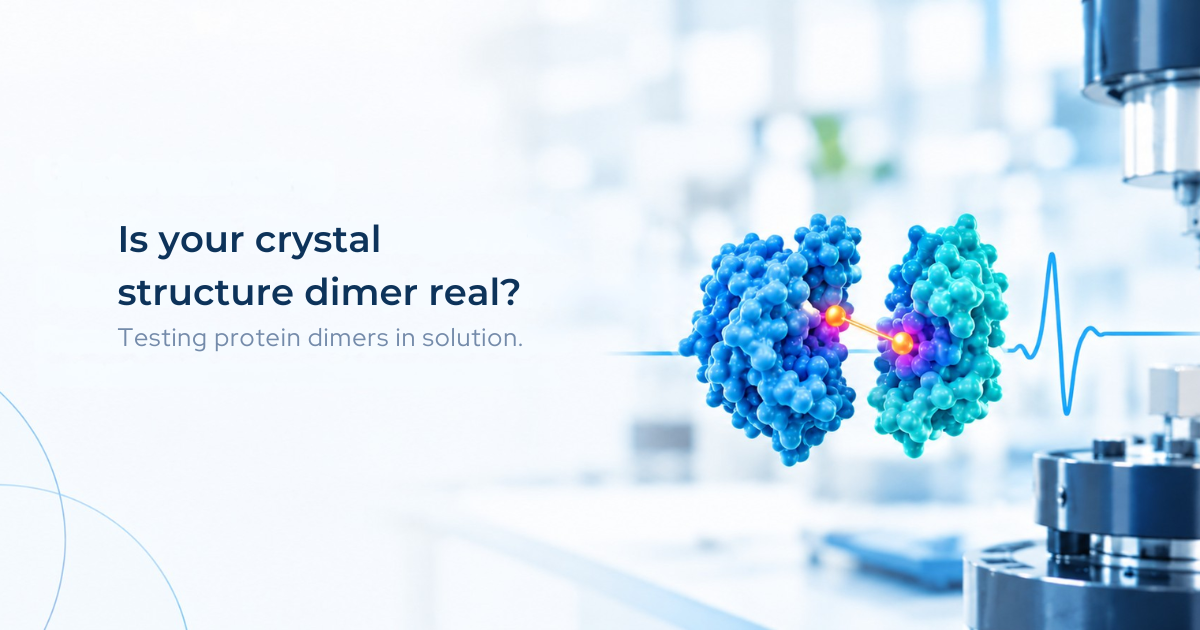
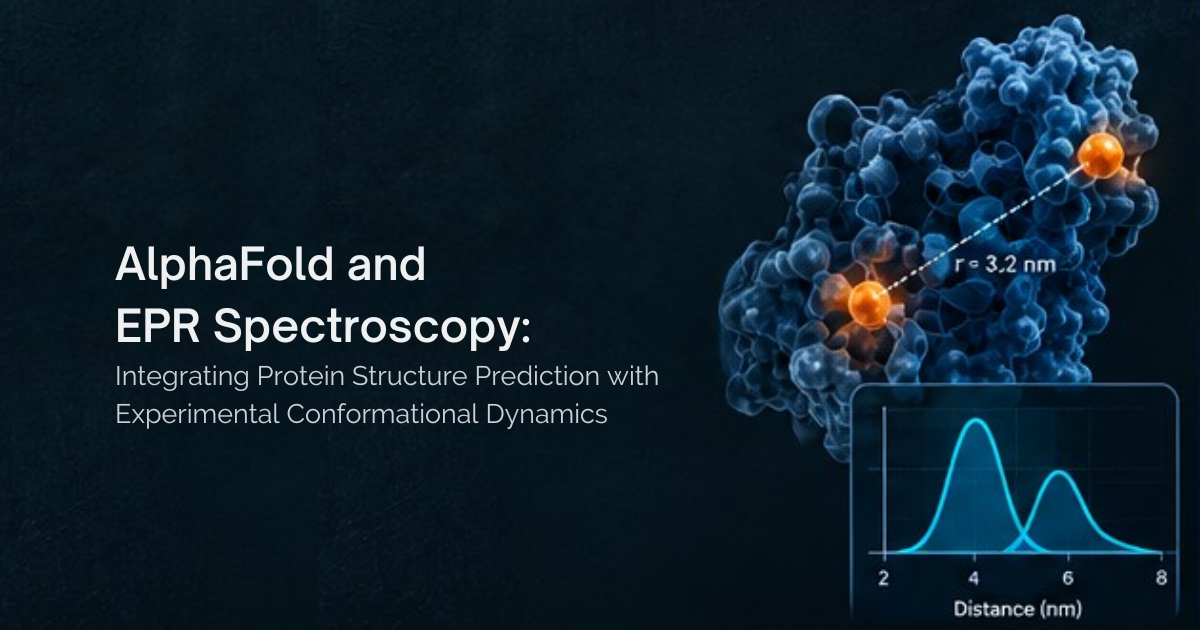
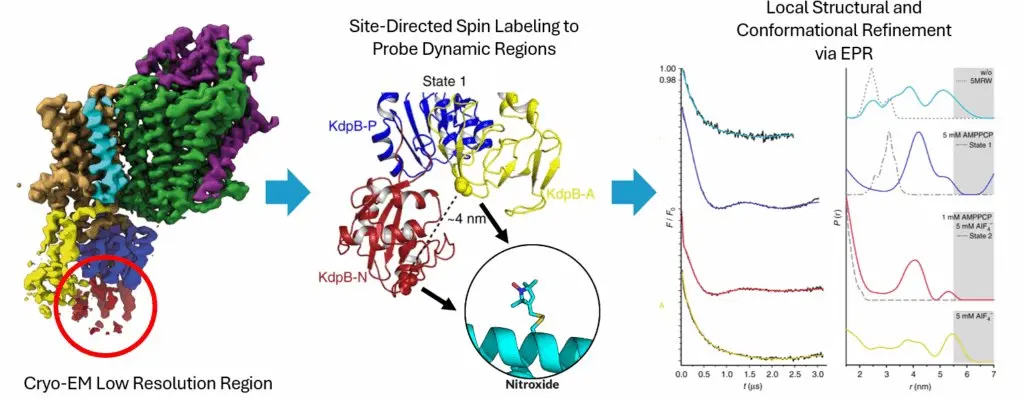
If you've been around the biophysical community in recent years, you may have also noticed a technique that has been gaining visibility: Electron Paramagnetic Resonance (EPR). EPR, and particularly dipolar EPR methods like DEER (Double Electron Electron Resonance), has proved itself capable of filling in those dynamic gaps in established structural data. DEER spectroscopy probes nanometer-scale interactions and provides dynamic information in the form of a distance distribution, a probability distribution of point-to-point distances between two sites within a protein or other macromolecule. This distribution represents the conformational ensemble as a whole, including transient and low-population states – precisely the kind of data necessary to more fully understand conformational heterogeneity, population shifts, or ensemble behavior. EPR complements X-Ray and Cryo-EM structures by providing experimental distance restraints, validates AlphaFold predictions by confirming whether a model reflects the actual conformational landscape, and extends NMR data by reaching into size and complexity regimes that are otherwise inaccessible.
For all its advantages, EPR has traditionally been operationally complex, unstable over long acquisition periods, and requires deep expertise to run, analyze, and interpret. For most biological labs, EPR has been something to collaborate on rather than a staple in-house technique. That's changing, and it's part of what we'll be showcasing at BPS 2026.
We bring you FATHOM, an integrated EPR system designed specifically for biotechnology applications with an emphasis on usability and stability. FATHOM aims to make EPR accessible, with automated sample handling, integrated data analysis, and reproducible, publication-ready results. You don't need to be an EPR specialist to get meaningful data. FATHOM's quantum sensor enables you to run without phase drift over long periods, which means we can work with low-concentration samples, difficult targets, and subtle conformational changes that require high signal-to-noise to resolve. If your protein populates multiple states, FATHOM can detect them.
The types of systems where this matters most are exactly the ones that will be prominent at BPS this year; intrinsically disordered proteins (IDP) and intrinsically disordered regions (IDR) are everywhere in signaling, transcription, and phase separation. Understanding how they work means characterizing their ensemble behavior and how that ensemble shifts in response to binding partners, post-translational modifications, or cellular conditions. With FATHOM, you can resolve population-level distance distributions that inform on IDP function. As mentioned with GPCRs, ligand efficacy isn't just about binding affinity, it’s also necessary to understand what conformational states are stabilized. FATHOM can shine a spotlight on these induced changes in distance distributions.
For protein-protein complexes, whether you're studying ternary complexes induced by PROTACs and molecular glues or trying to understand how adaptor proteins assemble into signaling scaffolds, FATHOM provides the distance constraints you need to validate models and resolve ambiguous states. For labs using Cryo-EM or AlphaFold, experimental distance distributions offer orthogonal validation for structural models. If your Cryo-EM map is ambiguous or your AlphaFold prediction seems plausible but unverified, EPR-derived constraints can confirm or refine the model.
Now, not every lab is ready to bring EPR in-house, and we have an answer for that: For those looking to test the waters first, High Q offers a fully customized sample measurement service (SMS). Designed for structural biology and drug discovery labs, you can send us your samples, and we will work with you to design the experiment, run the measurements, and deliver high-resolution distance and dynamics data with full analyses. These are fast turnaround, publication-quality results with complete IP protection. It's a way to explore what EPR can do for your specific system without committing to capital expenditure.
We're at BPS to shine a light on EPR and make it accessible via FATHOM and our Sample Measurement Service. We’re also here to understand where EPR can help unlock difficult problems, how it fits into existing structural pipelines, and what new applications might emerge as EPR becomes more accessible. We're interested in collaboration, method development, and pushing the boundaries of what EPR can measure. We want to hear about unmet needs in protein dynamics research and learn what would make EPR genuinely useful for your lab.
Quantum sensing is delivering practical impact in biology, and EPR is one of the first places where that's become real. Structural biology is entering an era where dynamics are first-class data, central to understanding how proteins work and how to drug them effectively. High Q's mission is to make that possible by making advanced EPR accessible, reliable, and routine.
Come find us at booth 704. Let's talk about what's possible.

EPR is a strong complement to the state of the art in structural biology, providing a wholistic view of a target protein. In tandem with other techniques, it can help us to deepen our understanding of biological structure and function and validate proposed mechanisms. Moreso, and in the spirit of collaboration, I am excited not only at the prospect of how EPR can help advance the field of drug discovery, but also how drug discovery can progress the application of EPR and the historically complex problems we can solve that would be unreachable alone.