Can you FATHOM this?
The latest insights on Electron Paramagnetic Resonance (EPR) spectroscopy trends, customer successes and industry best practises

Successful site-directed spin labelling (SDSL) starts with proper protein sample preparation. Before the spin-label reagent MTSL can attach to an engineered cysteine, the residue must be available in its reduced thiol form. What happens if cysteine oxidation interferes with labelling, and how can reducing agents such as DTT or TCEP help? Getting this step right is essential for efficient spin-label attachment and reliable EPR measurements.
Electron paramagnetic resonance (EPR) spectroscopy complements cryo-EM by measuring distance distributions between spin labels placed in the flexible loops, mobile domains and disordered segments that appear as weak or missing density in a cryo-EM map.
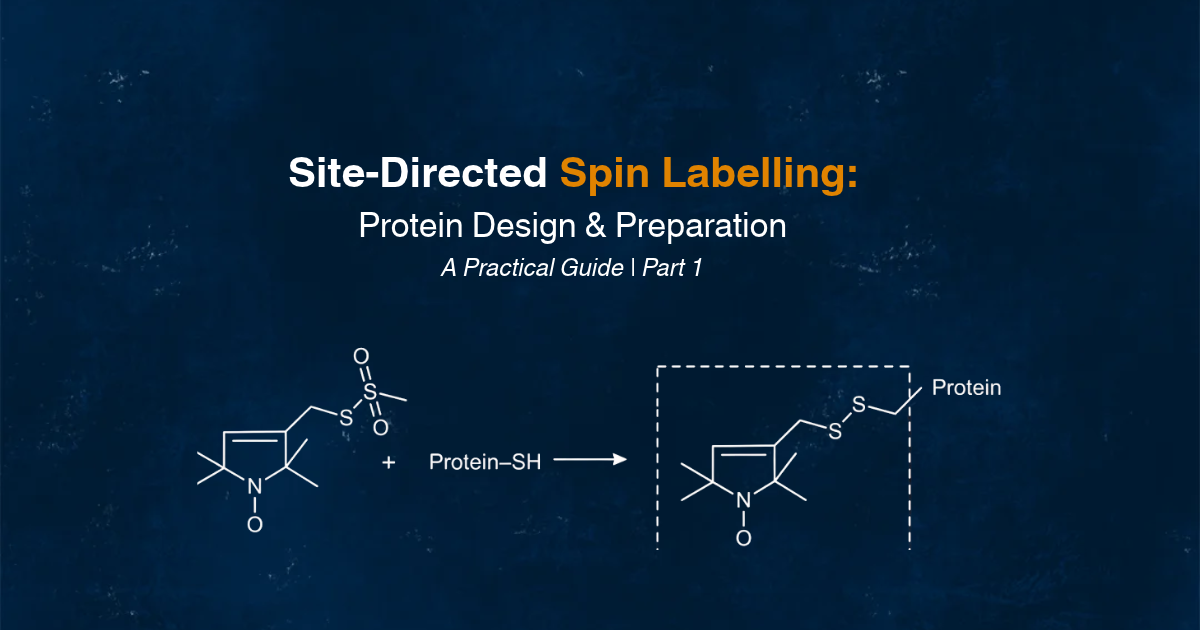
Site-directed spin labelling (SDSL) is a technique that combines protein engineering with electron paramagnetic resonance (EPR) spectroscopy to investigate protein structure, conformational changes and dynamics.
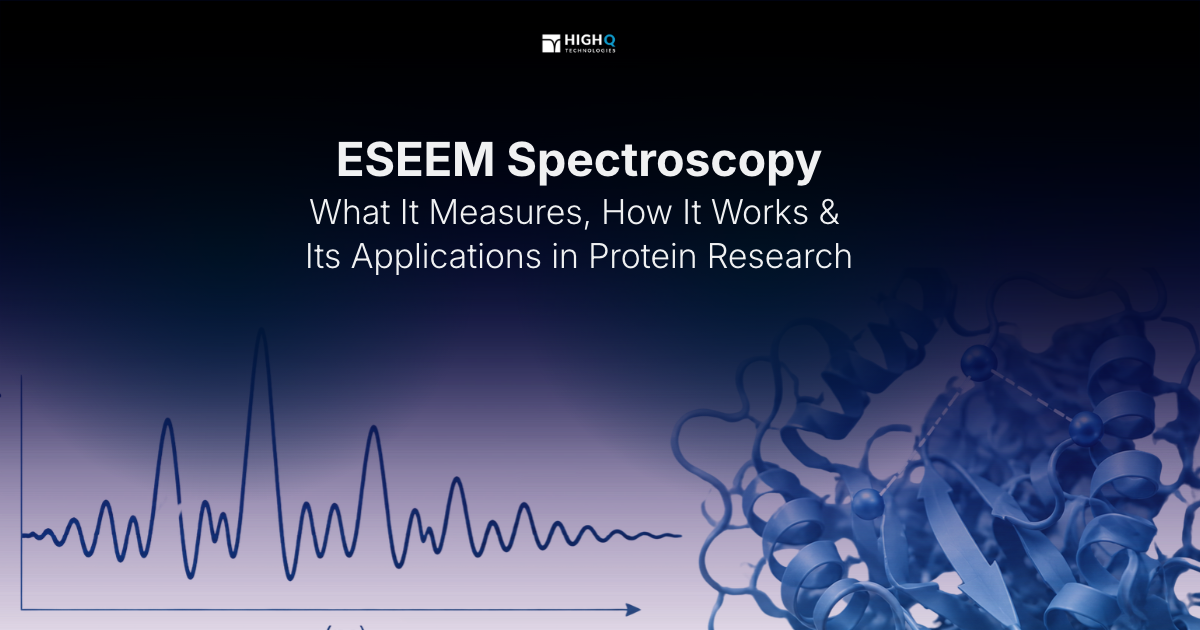
ESEEM and 2D ESEEM (HYSCORE) measure the magnetic nuclei around an unpaired electron, and you use one-dimensional ESEEM to check which nuclei are present, such as deuterium from solvent or nitrogen from a histidine ligand, and 2D ESEEM when signals overlap or you need to work out which frequencies belong to the same nucleus. Electron spin echo envelope modulation (ESEEM) is a pulsed EPR technique, and protein scientists use it to study metal-binding sites, enzyme active sites, protein–ligand interactions and membrane proteins. This guide is for researchers in structural biology, biophysics and drug discovery. It explains what each experiment measures, how two-pulse, three-pulse and HYSCORE experiments differ, and what four published protein studies found with them.

Despite being still an incredibly niche technique, the current state of EPR is something to be excited about. EPR – electron paramagnetic resonance – is a diverse and robust technique that can unlock biophysical information by measuring nanoscale intramolecular distances, determining localized dynamics, and probing paramagnetic binding environments. Every year talented investigators are using this spectroscopy to discover new information and solve old problems. I had the chance to interact with several such groups and see firsthand the new directions the field is heading.