.png)
Cryo-electron microscopy (cryo-EM), has transformed structural biology, making it possible to determine increasingly detailed structures of large protein complexes, membrane proteins, and macromolecular assemblies. But even an excellent cryo-EM reconstruction can contain regions where the density is weak, poorly defined, or absent altogether. This can include: Flexible loops, linkers, protein termini, individual domains, side chains, ligand-binding regions, regulatory elements and protein-protein interaction sites. And this creates an important scientific question: What does missing density actually mean? The answer is not always “the region is disordered.”
Poor or missing density can be associated with intrinsic disorder, local flexibility, multiple conformational states, continuous structural variation, incomplete occupancy, compositional heterogeneity, preferred orientations, alignment uncertainty, and other experimental or reconstruction factors. In other words, a structure can be solved while important questions about the protein's conformational behavior remain unanswered.
7 possible causes of missing or poorly resolved cryo-EM density
1. The region is intrinsically disordered
Some protein sequences do not adopt one stable three-dimensional structure under the experimental conditions. Instead, they can populate ensembles of rapidly interconverting conformations.These regions are often referred to as intrinsically disordered regions (IDRs).
IDRs are common in signaling proteins, regulatory proteins, transcription factors, protein interaction regions, flexible linkers and protein termini. If a region does not have a dominant structural position, it can be difficult to reconstruct as a single well-defined density. However, missing density alone does not establish that a region is intrinsically disordered. The same observation can arise from other types of structural heterogeneity.
2. The region is structured but flexible
A region does not have to be unfolded or intrinsically disordered to be difficult to resolve. A folded domain can undergo substantial motion relative to the rest of the protein. For example: Domain A ↔ Domain B. The individual domains may each be well resolved, while the relative orientation between them varies across particles.The result can be a high-quality reconstruction of the domains but poorly resolved density for the connecting region or for one domain relative to another. This distinction is important because: structured ≠ static. A protein can remain folded while undergoing substantial conformational motion.
3. The protein exists in multiple discrete conformational states
Consider a protein that exists as: State A ⇌ State B. If both states are sufficiently populated and structurally distinct, cryo-EM image-processing approaches may be able to separate them into different classes or reconstructions. But if the structural differences are subtle, the states overlap strongly, or one state is sparsely populated, separation can become more difficult. The resulting reconstruction may therefore contain poorly defined or missing density in the region undergoing the transition. Modern cryo-EM approaches can recover multiple conformations from heterogeneous particle populations, but the ability to resolve them depends on factors including the structural differences between states, their populations, data quality, and the analysis strategy.Most importantly: Missing or poorly resolved density can be consistent with conformational heterogeneity, but it does not by itself establish that multiple discrete states are present.
4. The protein undergoes continuous conformational changes
Not all protein motions can be described as two or three discrete structures.A protein may instead move through a continuum: State A → A₁ → A₂ → A₃ → State B. This is often referred to as continuous conformational heterogeneity.Instead of a small number of distinct structural states, the protein may occupy a broad landscape of related conformations. Cryo-EM computational methods have increasingly been developed to investigate continuous heterogeneity, but describing these landscapes remains challenging. A 2022 survey of methods described continuous heterogeneity and flexible regions as an important open problem, while subsequent work has continued to advance the field. This matters because a consensus reconstruction can compress a dynamic ensemble into a representation that does not fully describe the underlying motion.
5. The region has partial or dynamic ligand/partner occupancy
Another possibility is that a region interacts with another molecule in a heterogeneous manner. That molecule could be a small-molecule ligand, a cofactor, another protein, DNA, RNA, a membrane component , an antibody or other binding partner. For example, a ligand may not occupy exactly the same position in every particle.Or only a fraction of the particles may contain ligands. This can produce heterogeneous density around the binding site and potentially affect nearby protein conformations. The same principle applies to protein-protein interactions. If a binding partner associates transiently or with different orientations, the resulting density may be difficult to interpret.
6. The sample contains compositional or biochemical heterogeneity
Not every form of heterogeneity is conformational. Particles can differ because of different oligomeric states, partial ligand occupancy, different assembly states, proteolysis, post-translational modifications, different biochemical states and incomplete complex formation For example: Monomer ⇌ Dimer is fundamentally different from: Conformation A ⇌ Conformation B. Both can contribute to heterogeneity in a cryo-EM dataset, but they represent different biological questions. This is why it is important not to interpret every heterogeneous reconstruction as evidence of protein dynamics.
7. Experimental and reconstruction limitations
Some poorly resolved regions may reflect limitations in the data or reconstruction rather than an intrinsic property of the protein. Examples include preferred orientations, incomplete angular coverage, alignment uncertainty, particle quality. uneven distribution of views, local signal-to-noise limitations or reconstruction and masking effects. Local resolution analysis is particularly useful because a single global resolution value does not describe the quality of every region of a cryo-EM map. Different parts of the same reconstruction can have substantially different local resolution. Those variations can arise from both specimen properties and technical factors.Therefore: A high global resolution does not guarantee that every region of the structure is equally well resolved.
The important distinction: disorder, flexibility, or heterogeneity?
When a region disappears from a cryo-EM map, three descriptions are often used: Disordered, Flexible, Heterogeneous
But these terms are not interchangeable. A region could be:
- Intrinsically disordered: It does not adopt one stable structure.
- Locally flexible: It remains structured but samples multiple positions.
- Conformationally heterogeneous: The protein population contains distinguishable structural states.
- Continuously heterogeneous: The protein samples a continuum of related conformations.
- Experimentally unresolved: The molecular structure may be relatively well defined, but technical factors prevent the density from being reconstructed confidently.
The challenge is that the same visual observation, missing density can be compatible with several of these explanations. A 2026 scientific comment by Lin and Cheng in IUCrJ highlights precisely this problem: disappearing densities in single-particle cryo-EM can reflect protein dynamics, but the density itself does not necessarily reveal whether the underlying behavior is domain motion, local structural plasticity, partial unfolding, or another form of heterogeneity.
What should you do when cryo-EM cannot resolve a region?
The first step should be to determine what information can already be extracted from the cryo-EM dataset. Depending on the system, researchers can investigate local resolution, 2D classification, 3D classification, focused classification, heterogeneous refinement, 3D variability analysis, multiple reconstructions or continuous heterogeneity analysis. These approaches can reveal additional structural states in some datasets.But they cannot necessarily resolve every form of molecular motion. As Lin and Cheng noted in 2026, even extensive image-processing approaches may fail to recover meaningful intermediates from some unresolved regions.When that happens, the next question becomes: What complementary measurement can tell us what the cryo-EM map cannot?
NMR: investigating dynamics at the residue level
Nuclear magnetic resonance (NMR) spectroscopy provides a different window into protein structure and dynamics.For suitable systems, NMR can provide information about:
- Residue-level environments
- Conformational exchange
- Local dynamics
- Intrinsically disordered regions
- Ligand interactions
- Solution-state behavior
This can be particularly useful when the question concerns which residues are changing and how they exchange between states. However, NMR also has practical constraints, including molecular size, concentration, spectral complexity, and sample requirements. The choice therefore depends on the protein and the specific scientific question.
HDX-MS: probing changes in dynamics and accessibility
Hydrogen-deuterium exchange mass spectrometry (HDX-MS) can provide complementary information about protein dynamics and solvent accessibility. For example, comparing: Apo protein with Protein + ligand can reveal regions whose exchange behavior changes upon binding. This can help identify regions that become more protected, exposed, or dynamically altered. The 2026 IUCrJ discussion of invisible cryo-EM densities specifically highlights HDX as one experimental approach that can provide information about dynamic and energetic behavior in regions that remain unresolved by cryo-EM.
EPR and DEER spectroscopy: measuring site-specific distances within dynamic systems
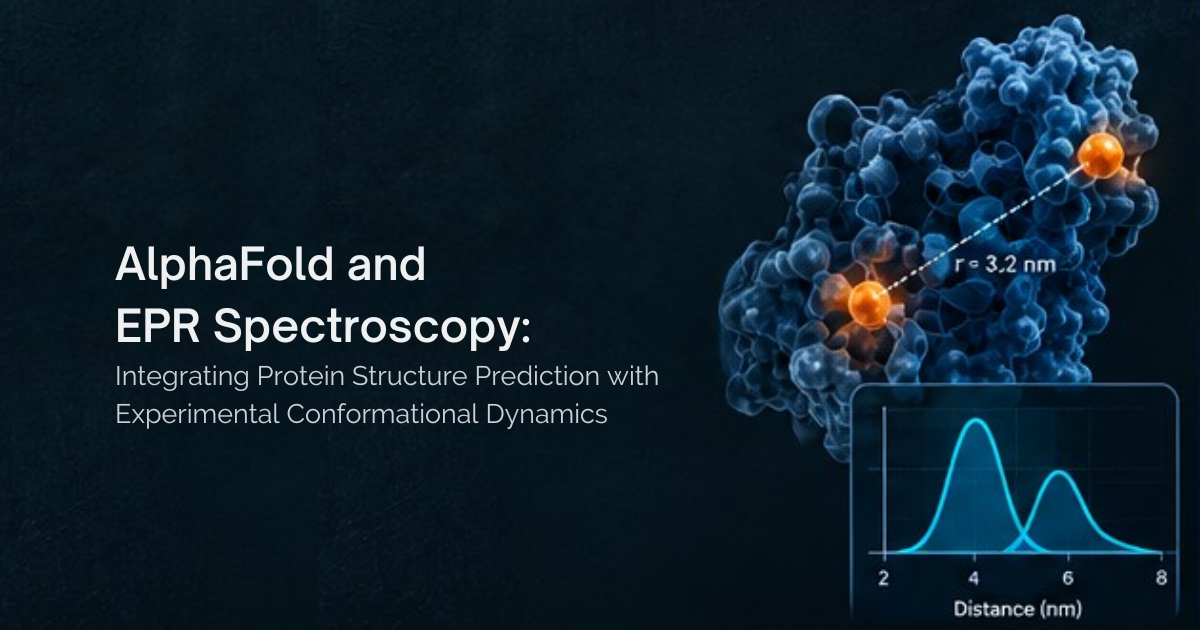
Electron paramagnetic resonance (EPR) provides another complementary experimental perspective. In structural biology, site-directed spin labeling can be used to introduce paramagnetic probes at selected positions in a protein. Pulsed EPR methods such as double electron-electron resonance (DEER/PELDOR) can then measure the distance between pairs of spin labels. One important advantage is that the output can be a distance distribution, rather than simply a single distance. Conceptually: P(r) describes the distribution of distances represented in the measurement. That distribution can contain information about conformational heterogeneity.
From “Why is this region blurry?” to “What distances are populated?”
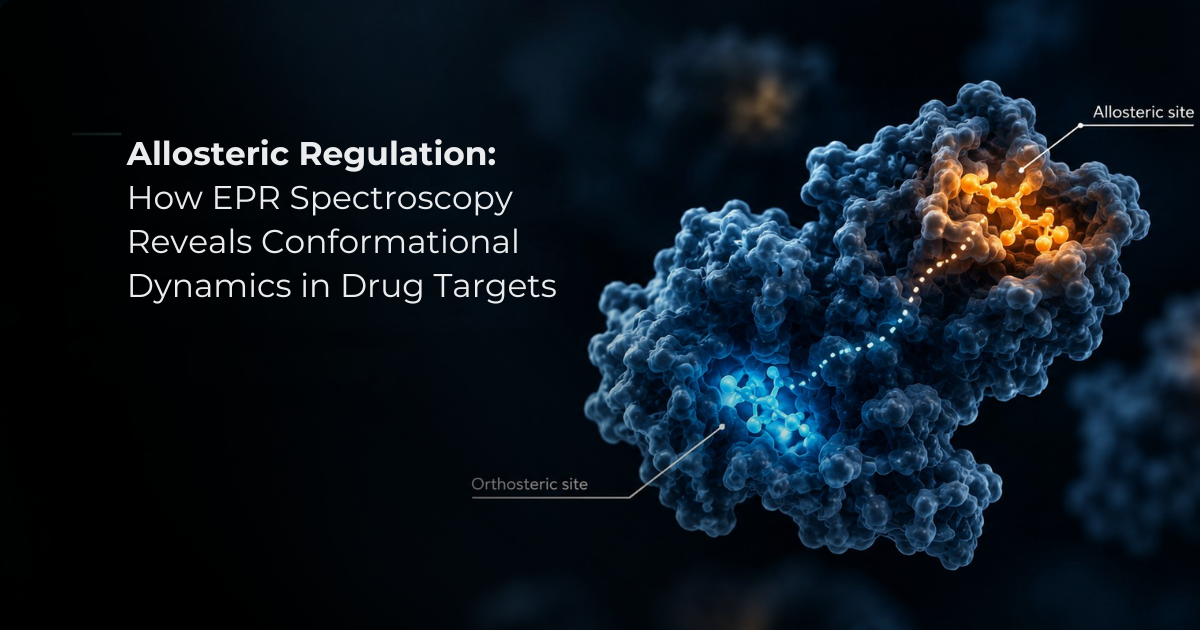
Imagine a cryo-EM structure in which two domains appear to adopt different relative orientations, but the connecting region or domain movement is poorly resolved. You could introduce spin labels at selected positions on the two domains. If different conformational states produce sufficiently distinct inter-spin distance distributions and both states are appreciably populated, DEER may resolve multiple components in the measured distance distribution. Conceptually: Conformation A → distance distribution centered around r₁ and Conformation B → distance distribution centered around r₂. The resulting measurement provides an experimental constraint on the conformational ensemble. What if ligand binding changes the unresolved region? This becomes particularly interesting in drug discovery. Suppose a target protein has a cryo-EM structure in its apo state. A ligand-bound structure reveals a different arrangement. It is tempting to describe this simply as: Apo → ligand-bound structure. But the solution-state behavior may be more complicated. The protein could exist as: State A ⇌ State B with ligand binding shifting the equilibrium: Before ligand: State A 70% while State B 30% After ligand:, State A 25%
while State B 75%. The important concept is the population shift. A ligand may stabilize one member of a pre-existing ensemble rather than simply creating a completely new structure. This is one reason why understanding protein conformational ensembles can be important for drug discovery.
A practical decision framework
If you have unresolved density in a cryo-EM structure, consider the following questions.
1. Could the region be intrinsically disordered?
If so, consider techniques capable of characterizing disordered ensembles and dynamics.
2. Does cryo-EM classification reveal multiple states?
If yes, determine whether those states correspond to meaningful biochemical or functional differences.
3. Does the region appear to undergo continuous motion?
If so, methods designed to interrogate conformational ensembles may provide additional information beyond discrete reconstructions.
4. Does ligand binding alter the region?
Compare apo and ligand-bound conditions using complementary structural or biophysical approaches.
5. Do you need site-specific distance information?
EPR/DEER may be particularly useful when strategically selected sites can report on the structural transition.
6. Do you need to estimate relative populations?
Consider approaches that can quantitatively constrain conformational populations. For DEER, this requires appropriate experimental design and model-based interpretation rather than simply equating individual peaks with individual states.
Key takeaways
1. Missing cryo-EM density does not automatically mean intrinsic disorder.
Flexibility, conformational heterogeneity, incomplete occupancy, compositional heterogeneity, preferred orientation, alignment uncertainty, and other factors can contribute.
2. A high global resolution does not mean every region is equally well resolved.
Local resolution can vary substantially throughout the same reconstruction.
3. Cryo-EM can reveal multiple conformational states, but not every form of heterogeneity is easily resolved.
Discrete states may be separated in some datasets, while continuous or low-population states can remain difficult to characterize.
4. Missing density should be treated as a question
It can motivate hypotheses about disorder, flexibility, conformational heterogeneity, occupancy, or experimental limitations.
5. DEER provides distance distributions
With appropriate labeling, structural modeling, and rigorous analysis, those distributions can provide quantitative constraints on conformational heterogeneity and state populations.
6. Cryo-EM, NMR, HDX-MS, and EPR can provide complementary information.
The strongest approach is often not to ask which technique is “best,” but which measurement can answer the unresolved biological question.
Frequently Asked Questions
Why are some regions missing from a cryo-EM structure?
Possible explanations include intrinsic disorder, local or domain flexibility, discrete or continuous conformational heterogeneity, partial occupancy, compositional heterogeneity, preferred orientations, alignment uncertainty, and other reconstruction or data-quality limitations.
Does missing cryo-EM density mean a region is disordered?
No. Missing density alone cannot distinguish intrinsic disorder from flexibility, conformational heterogeneity, incomplete occupancy, or technical factors.
Can cryo-EM detect multiple protein conformations?
Yes. Cryo-EM image-analysis approaches can resolve multiple discrete conformations in suitable datasets, and newer methods can investigate continuous conformational heterogeneity. The ability to distinguish states depends on factors such as population, structural separation, data quality, and analysis strategy.
What can I use to study regions that cryo-EM cannot resolve?
Depending on the scientific question and protein system, options include NMR, HDX-MS, EPR/DEER, biochemical assays, computational modeling, and integrated approaches.
Can EPR investigate regions that are unresolved by cryo-EM?
EPR can provide complementary information when suitable labeling sites can be introduced near or across the region of interest. DEER can measure inter-spin distance distributions and thereby provide experimental constraints on structural heterogeneity.
Does a DEER peak correspond to a protein conformation?
Not necessarily. A DEER distance distribution reflects inter-spin distances and can be influenced by protein conformations, spin-label rotamers, structural disorder, and other factors. Assigning distance components to specific conformations requires structural context and appropriate modeling.
Can DEER quantify conformational state populations?
Under appropriate experimental and modeling conditions, yes. Model-based analysis of DEER data can relate distance-distribution components to structurally defined conformations and estimate their fractional populations, with uncertainty analysis.
Can EPR detect ligand-induced conformational changes?
Yes. Comparing EPR measurements under different biochemical conditions can reveal changes in distance distributions or other spectroscopic observables associated with ligand-dependent structural changes. The interpretation depends on the labeling strategy and experimental design.
References
1. Lin, X. & Cheng, Y. (2026). Making sense of invisible densities in single-particle cryo-EM. IUCrJ, 13, 217–220.
DOI: 10.1107/S2052252526002952.
2. Cardone, G., Heymann, J. B. & Steven, A. C. (2013). One number does not fit all: mapping local variations in resolution in cryo-EM reconstructions. Journal of Structural Biology, 184, 329–336.
3. Kucukelbir, A., Sigworth, F. J. & Tagare, H. D. (2014). Quantifying the local resolution of cryo-EM density maps. Nature Methods, 11, 63–65.
5. Stein, R. A. et al. (2021). Protein functional dynamics from the rigorous global analysis of DEER data: Conditions, components, and conformations. Journal of General Physiology, 153
Other Electron Paramagnetic Resonance Spectroscopy Resources
- What Is EPR Spectroscopy and DEER Spectroscopy?
- EPR/DEER for Membrane Proteins
- FATHOM EPR / Sample Measurement Service